LGBTQ+ Pride
 Celebrating our LBGTQ+ Community
Check out the resources and materials we’ve put together to inform and celebrate the LGBTQ+ community in Los Angeles County and beyond. This page is updated regularly, so feel free to check back for more new and exciting videos, booklists, activities, learning pathways, and more. There’s also info on accessing relevant archives on LGBTQ+ history that researchers will find valuable
LGBTQ+ Collection at the West Hollywood Library
Our West Hollywood Library holds our LGBTQ+ Collection, a comprehensive collection of LGBTQ+ fiction and non-fiction literature and history in a variety of formats: books, journals, periodicals, VHS, and DVD. The collection reflects the rich history, culture, and experiences of the LGBTQ+ community both locally and globally. It includes popular and academic materials, out-of-print and hard-to-find titles, LGBTQ+ classics, current bestsellers, and new Lambda Literary Award winners and nominees.
Featured Event
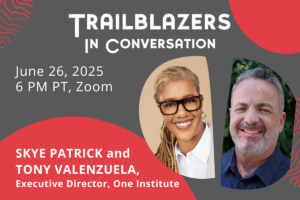
Trailblazers in Conversation with Tony Valenzuela
Join us as LA County Librarian Skye Patrick sits down with Tony Valenzuela, the Executive Director of One Institute, to discuss the history of LGBTQ+ activism in Los Angeles, why our histories matter, and what it means to support the next generation of storytellers and activists.
Watch event recording
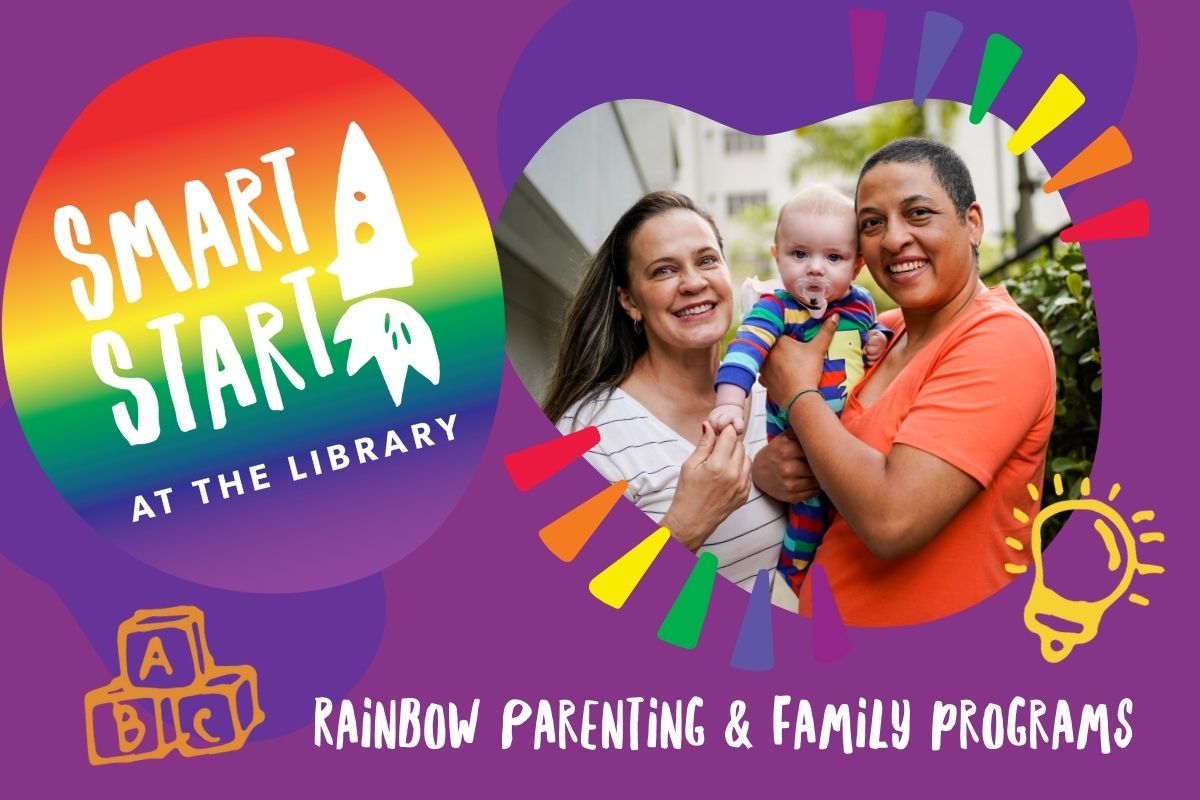 Rainbow Parenting & Family Programs
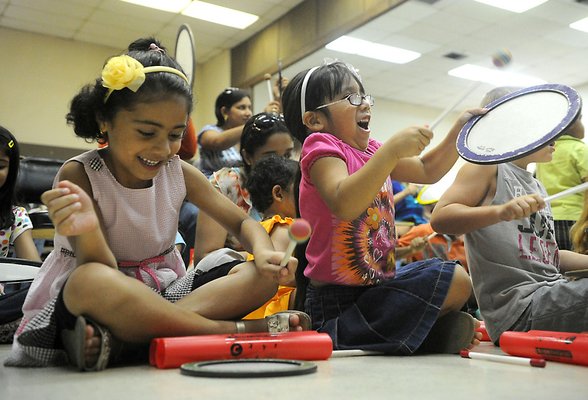
LA County Library’s Rainbow Parenting and Family Programs strive to build community and create a safe space for LGBTQ+ families in the library. Meet other local families, share experiences, inspire and encourage each other! Programs are specially designed for families of younger kids, ages birth – 5 years, and their families.
Learn more about these programs and where they are available.
Featured LGBTQ+ Trailblazers
Learn the stories of advocates that helped advance LGBTQ+ rights in the United States. Click the plus sign (+) for the full bios and links to items available to borrow with your LA County Library card.
Bessie Smith
Remembered as the “Empress of the Blues,” Bessie Smith (1894 - 1937) was a highly influential blues singer and entertainer during the Jazz Age and Harlem Renaissance.
Smith incorporated the hardships of being Black working class into her lyrics by singing about poverty, racism, and sexism in addition to singing about female sexuality and love. Her ability to channel her life experience and personality into her voice made her stand out.
Elizabeth “Bessie” Smith was the youngest child of seven, born April 15, 1894, in Chattanooga, Tennessee to Laura and William Smith. Her father was a Baptist minister and day laborer and her mother a laundress. By 1906 Bessie and five of her siblings were orphans after the deaths of their parents and brother, causing Smith to begin singing as a street performer. Over time she refined her vocal style on the Black vaudeville stage and became a mentee of Ma Rainey.
By age 24, Bessie Smith had her own solo acts and was performing throughout the South and East Coast. In 1923, she signed with Columbia Records and had one of her first hits, “Down-hearted Blues”, which went on to sell two million copies and launched her into the national spotlight. Bessie Smith was not just a blues entertainer she played and recorded with jazz musicians such as Sidney Bechet and Louis Armstrong. Her talents led her to become the highest paid Black entertainer of her time. Her last recording was in 1933 due to the Great Depression, but Smith continued to travel and tour the country. While enroute to Chattanooga Bessie Smith suffered fatal injuries in Clarksdale, Mississippi in a car accident. Her funeral was attended by more than 5,000 people in Philadelphia where she had been residing.
With a discography that contains 160 recorded songs, three of which have been inducted into the Grammy Hall of Fame, Bessie Smith is a Blues icon. In 1984, Bessie Smith was inducted into the National Women’s Hall of Fame and in 1989 she was inducted into the Rock and Roll Hall of Fame. Her lyrics live on and the inscription on her headstone rings true, “The greatest blues singer in the world will never stop singing.”
Books
Bessie Smith by Jackie Kay
The Bessie Smith companion: a critical and detailed appreciation of the recordings by Edward Brooks
Blues legacies and Black feminism: Gertrude "Ma" Rainey, Bessie Smith and Billie Holiday by Angela Y. Davis
Queer blues: the hidden figures of early blues music by Darryl W. Bullock
Resource Links:
"Bessie Smith” at Bessie Smith Cultural Center
"Bessie Smith” at National Museum of African American History & Culture
"Bessie Smith Jazz Singer” at Trump Kennedy Center
"Bessie Smith” at the Rock & Roll Hall of Fame
"Bessie Smith” at National Women’s Hall of Fame
We’wha
Spiritual leader and artist We’wha took on both female and male social and cultural gender roles within the A:Shiwi (Zuni) People.
He was vital in establishing relations between the Zuni Tribe and the United States government. Many scholars credit We’wha as a key figure who helped popularize Southwest Native traditional arts, which allowed him to advocate for his community and to protect Zuni lands.
Born around 1849 in present-day New Mexico to the Pueblo of Zuni, We’wha was orphaned as a baby and raised by his paternal aunt. At an early age We’wha was recognized as a lhmana, a third gender status in Zuni culture, where a person who was assigned male at birth took on both male and female social traits. Zuni social roles were determined by life experiences and a series of initiations, not the sex of one’s gender. While many Americans had exoticized We’wha as a “Zuni Princess” and believed him to be a woman, Zunis referred to We’wha with male kinship terms. We’wha was initiated into the kachina society, a group of men responsible for performing religious ceremonies for spiritual beings. He was also well known for his skills in pottery, an art done by both men and women, and weaving, which was predominantly done by women.
When the Bureau of Ethnology sent an expedition to study the Zuni people, anthropologists James Stevenson and his wife Matilda Stevenson learned how much knowledge We’wha had about his people and the important role We’wha held in his community. The Stevensons originally assumed We’wha was a woman, but later discovered that We’wha was an lhamana. After James Stevenson died, it was We’wha’s friendship with Maltilda Stevenson and his role as an informant to the Bureau of Ethnology that paved the way for We’wha’s trip to Washington D.C. During We’wha’s six month stay, he met with dignitaries including President Grover Cleveland, gave weaving demonstrations, and became popular amongst the Washington locals. The art demonstrations strengthened the economic development of Southwest tribes, popularizing Southwest Native art and increasing commercialism. The good impression We’wha left in Washington D.C. laid the foundation to a positive relation between future Zuni representatives and the United States government, securing further protection of the Zuni reservation’s boundaries.
We’wha’s was so well respected in his community that his death in 1896 was considered a calamity. Not only was he an influential figure to the Zuni people, but generations later he is now considered one of the most famous two-spirit pioneers in Native American history.
Books
The Zuni Man-Woman by Will Roscoe
Rainbow Revolutionaries by Sarah Prager, illustrated by Sarah Papworth (e-book available via Libby)
Resource Links
"5 Two-Spirit Heroes Who Paved the Way for Today’s Native LGBTQ+ Community” at KQED
“We’wha” at National Women’s History Museum
"We’wha” in Encyclopedia of Lesbian, Gay, Bisexual and Transgender History in America (library card required)
"We’wha and Klah The American Indian Berdache as Artist and Priest.” The American Indian Quarterly Journal of American Indian Studies, Volume XII, Number 2, Spring 1988. (available via JSTOR)
George Takei
George Takei is an acclaimed actor, author, and activist whose career and advocacy have made him one of the most influential Asian American and LGBTQ+ public figures of his generation.
He is best known for his groundbreaking role as Lieutenant Hikaru Sulu on Star Trek, which debuted in 1966 and marked one of the first positive, non-stereotypical portrayals of an Asian American character on American television. Through this role, Takei helped expand visibility and representation for Asian Americans in popular culture.
Born in Los Angeles in 1937, Takei’s early life was shaped by the U.S. government’s incarceration of Japanese Americans during World War II. He and his family were forcibly removed from their home and confined in internment camps, an experience that profoundly influenced his lifelong commitment to civil rights and social justice. Takei has since become one of the most prominent voices educating the public about this dark chapter in American history, emphasizing the importance of remembrance, accountability, and vigilance against injustice.
In 2005, Takei publicly came out as gay, becoming a powerful advocate for LGBTQ+ visibility and equality. He has used his platform to speak candidly about the intersections of his identities as a gay man and a Japanese American, highlighting the importance of representation, dignity, and inclusion. His advocacy played a notable role in advancing marriage equality, particularly in California, where he and his husband Brad Altman were among the first same-sex couples to marry when it became legal.
Takei’s literary contributions extend his activism across generations through accessible and powerful storytelling. His acclaimed graphic memoir They Called Us Enemy recounts his childhood experience in incarceration camps and is widely used in libraries and classrooms. His children’s book My Lost Freedom presents this history in a gentle, age-appropriate way, helping young readers understand themes of justice, empathy, and belonging. Most recently, It Rhymes with Takei his graphic memoir about coming out later in life, celebrates queer identity, resilience, and the joy of living authentically.
Through decades of artistic achievement and tireless advocacy, George Takei has transformed personal experience into collective empowerment. His work continues to uplift Asian American voices, champion LGBTQ+ rights, and remind audiences of the power of storytelling to foster empathy, justice, and change.
Books
It Rhymes with Takei by George Takei
They Called Us Enemy by George Takei
My Lost Freedom by George Takei
To the Stars: The Autobiography of Star Trek's Mr. Sulu by Geoge Takei
Film and Video
“Why I love a country that once betrayed me | George Takei” at TED Talk
To Be Takei at Kanopy
Star Trek II: The Wrath of Khan at Kanopy
Star Trek III: The Search for Spock at Kanopy
Star Trek IV: The Voyage Home at Kanopy
Resource Links
George Takei Official Website
“George Takei Keeps Faith with Democracy” in The New York Times
“George Takei is 88 years old and will never stop fighting for equality” at CNN
“George Takei Says Coming Out at 68 Years Old Allowed Him to Feel 'Whole': 'It Feels Very Liberating'” in People Magazine

Pedro Almodóvar
Pedro Almodóvar is one of Spain’s most important filmmakers. Beyond his numerous awards and accolades, his work helped define Spain’s La Movida Madrileña cultural movement.
His work includes strong LGBTQ+ representation, strong female characters and a bold use of color and music.
Pedro Almodóvar is recognized as one of the most important filmmakers of modern Spanish cinema. He was born in the small town of Calzada de Calatrava Spain in 1949. At eight years of age, his family sent him to boarding school in the city of Cáceres. They had hoped he would become a priest, however he began attending the city’s cinema. He has said that the cinema opened up a new world for him and became his real education. He became drawn to filmmaking. In 1967, against his family's wishes, he moved to Madrid to attend Spain’s National School of Cinema. Unfortunately, Spain’s government under the dictator Franco closed the school. Undaunted, Almodóvar became a self-taught filmmaker.
Almodóvar’s career blossomed at a time when Spain, with the collapse of the Franco government, underwent a great opening of culture and freedoms. These events gave rise to a cultural movement called La Movida Madrileña. The movement represented a break from the censorship and repression of the Franco regime. It was characterized by filmmaking that celebrated youth culture, sexual liberation, bold fashion and unconventional lifestyles. As a filmmaker, Almodóvar became one of the key voices in this movement.
Themes in his work include strong LGBTQ+ representation, strong female characters, and a bold use of color, music and melodrama. He often blends comedy, tragedy and the grotesque. Some of his most impactful films include his first film Pepi, Luci, Bom and Other Girls Like Mom (1980) which is considered a defining film of the La Movida Madrileña movement, Women on the Verge of a Nervous Breakdown (1988) which was Almodóvar’s first international breakthrough, and All About My Mother (1999) which won the Academy Award for Best International Feature Film.
Almodóvar is an openly gay man whose work has played a large role in LGBTQ+ visibility and representation. Though he prefers to keep his personal life private, he has been vocal in condemning homophobia and censorship. He supports same sex marriage and uses interviews and speeches to defend LGBTQ+ rights.
Books
A Companion to Pedro Almodóvar by Various Authors
Pedro Almodóvar : interviews by Pedro Almodóvar
The passion of Pedro Almodóvar : a self-portrait in seven films by Pedro Almodóvar
Gay directors, gay films?: Pedro Almodóvar, Terence Davies, Todd Haynes, Gus Van Sant, John Waters by Emanuel Levy
Films
Todo sobre mi madre (All About My Mother, 1999)|
Volver (2006)
Mujeres al borde de un ataque de "nervios" (Women on the Verge of a Nervous Breakdown,1988)
Dolor y gloria (Pain and Glory, 2019)
La mala educación (Bad Education, 2004)
Resource Links
Interview: Pedro Almodóvar by Michal Koresky at Filmcomment.com
Pedro Almodóvar: “Keep it on the Rails” by Patrick Heidmann at The-Talks.com
Pedro Almodóvar Q&A on Finding Inspiration and Pain and Glory via YouTube
Pedro Almodóvar: On Directing via YouTube
Celebrate Pride for Adults
LGBTQ+ Romance for Adults
LGBTQ+ Cozy Novels for Adults
2026 Lambda Literary Award Finalists
LGBTQ+ Graphic Novels for Adults
LGBTQ+ Poetry
Life Is Funny That Way: Humorous LGBTQ+ Memoirs
World AIDS Day
LGBTQ Authors Writing in Spanish / Autores LGBTQ que escriben en español
Activities & Resources
Host a film festival in your community, college, school, or just in the comfort of your own home with friends and family. We’ve gathered a list of films and included a viewers guide to help you get started.
You can also check out our Learning Pathways for opportunities to dig deeper into topics impacting the LGBTQ+ community, and view our at-home activity ideas for some fun ways to celebrate Pride Month.
Virtual Film Fest
Viewer’s Guide: Hearts Beat Loud
Viewer’s Guide: Brother Outsider
Viewer’s Guide: Stonewall Uprising
Viewer’s Guide: The Adventures of Priscilla Queen of the Desert
Viewer’s Guide: The Way He Looks
Viewer’s Guide: Watermelon Woman
Learning Pathways
Learning Pathway: Gender Expansiveness & Queer Electronic Music
Featured Activity Idea
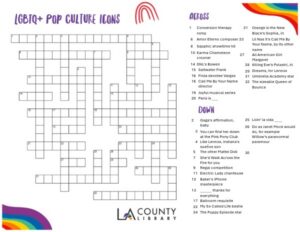
How well do you know pop culture? Find out by doing our LGBTQ+ Pop Culture Icons Crossword puzzle.
Additional Activity Ideas
Activity Idea: Pride Parade Fan
Activity Idea: Lifeguard Tower at Ginger Rogers Beach Coloring Page
Activity Idea: NaNoWriMo Prompts
Activity Idea: Thank You Letter to Queer Pioneers
Activity Idea: Queer Vision Board
Learning Opportunity: The March Towards Equality: A Timeline of LGBTQ+ Rights and Civic Engagement